Hydrogen gas generation offers potential advantages for automotive demonstrations, educational demonstrations, and on-site gas supply for small-scale experiments. This article highlights five notable products that align with car-related hydrogen needs, from compact hydrogen generators to educational kits that illustrate the principles behind clean energy and fuel cells. Each option is described with its key features to help you compare performance, safety, and practicality for lab or workshop use.
| Product | Brand | Primary Focus |
|---|---|---|
| High-Efficiency Hydrogen Gas Generator, 300ML/Min | PreAsion Store | Laboratory-grade hydrogen purity for test benches |
| Hydrogen Fuel Cell Electric Car Kit | Aitoserlea Store | Educational and demonstration fuel-cell technology |
| Oxy Hydrogen Gas Torch Generator | — | Welding, burning, and light industrial uses |
| Hydrogen Water Bottle Deluxe | BESTING Store | Hydrogen-rich water for wellness demonstrations |
| Solar Hydrogen Education Kit | Horizon Store | Solar-powered hydrogen education and exploration |
High-Efficiency Hydrogen Gas Generator for Laboratory Use

The High-Efficiency Hydrogen Gas Generator from PreAsion Store delivers a high-purity hydrogen output suitable for laboratory and industrial testing. It features a straightforward on/off operation, with distilled water as the primary consumable for continuous or intermittent use. The system is designed to maintain a hydrogen purity of 99.999%, supported by a large electrolysis area and a stable temperature profile to optimize gas production. A real-time LED display shows flow rate, enabling visual monitoring and easy integration with gas chromatography equipment. This generator is positioned to replace high-pressure cylinder usage in compact workflows.
Key advantages include ease of operation, high purity, and stable performance. The device emphasizes safety and reliability, with a stable hydrogen release pressure and transparent monitoring. It appeals to automotive and engineering labs needing a dependable hydrogen source for detector validation, calibration, or demonstration experiments related to fuel cells and hydrogen-powered concepts in vehicles.
Hydrogen Fuel Cell Car Kit for Educational Demonstrations
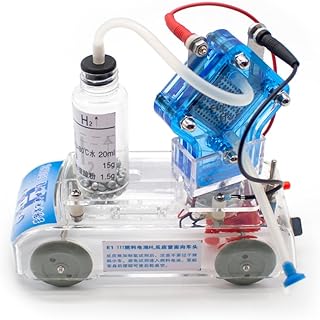
The Hydrogen Fuel Cell Electric Car Kit from Aitoserlea Store demonstrates how hydrogen and oxygen can generate electricity to power a small vehicle. The kit uses zinc particles and food-grade citric acid to synthesize hydrogen, which then drives the fuel cell. It includes guidance on reaction temperatures and venting to ensure operation remains within safe, controlled conditions. While primarily an educational tool, the kit provides a hands-on look at how hydrogen can interact with air in a fuel cell to produce usable electrical power for mobility concepts.
This product is notable for its teaching utility and practical demonstration of fuel-cell principles. Operators should monitor water temperature and venting operations to maintain consistent gas production and avoid issues that could affect performance. It is suitable for classrooms, workshops, and demonstrations that illustrate the fundamentals of hydrogen-based power for automotive applications.
Oxy-Hydrogen Gas Torch Generator

The Universal Oxy Hydrogen Gas Torch Generator combines brass construction with chromium plating and a robust handle designed for durability in professional settings. This unit is marketed for oxy-hydrogen flame generation and is suitable for welding, jewelry work, cable repair, hardening, and related tasks. The design emphasizes precise needle-value regulation and professional manufacturing for safe and reliable operation in environments that require a controlled flame and clean energy source. The torch is spread across a range of applications, including hull paint removal and waterproofing-related tasks.
Users should consider compatibility with safety standards, the availability of venting controls, and the overall safety profile when integrating this torch into a car-oriented or workshop environment. While not a direct vehicle fuel source, it demonstrates the practical use of hydrogen-oxygen flames in automotive maintenance, metalworking, and finishing tasks that may accompany car projects or demonstrations of hydrogen uses in a practical context.
Hydrogen Water Bottle Deluxe Version

The Hydrogen Water Bottle Deluxe uses SPE/PEM electrolysis to enrich water with dissolved hydrogen, delivering rapid concentrations up to 9000 ppb. The device supports fast production with a claimed improvement in antioxidant potential, aiming to illustrate hydrogen’s health-oriented demonstrations in a consumer-friendly form factor. The bottle is constructed from Tritan material with a scratch-resistant coating, and the sealed lid doubles as a small storage container. A built-in pressure valve enhances safety by preventing pressure buildup during operation.
Although designed for hydrogen-enriched drinking water, this product can be referenced in car-related demonstrations that involve wellness-oriented tech or in settings where hydrogen generation concepts are explained in a portable, user-friendly manner. Operating guidance emphasizes not to repeatedly produce hydrogen without opening the lid, ensuring safe use in any demonstration or personal-use scenario.
Solar Hydrogen Education Kit

The Horizon Solar Hydrogen Education Kit focuses on renewable energy principles by generating hydrogen using solar power and water. This educational set demonstrates how solar energy can drive hydrogen production, aligning with broader themes of clean energy and fuel-cell technology. It supports learners and hobbyists seeking real-world insight into how sun-driven hydrogen can contribute to power generation, including conceptual connections to automotive applications that rely on hydrogen as a clean energy carrier.
While primarily educational, the kit can complement car-focused projects that aim to visualize sustainable energy systems. It offers a hands-on perspective on hydrogen production, storage considerations, and the broader implications of integrating hydrogen into vehicles and energy infrastructure. Safety considerations and proper handling of hydrogen gas are important components of any classroom or workshop use.
Buying Guide: Key Purchase Considerations for Hydrogen Generators
- Output purity and stability: For automotive-related demonstrations or testing, choose systems offering high-purity hydrogen with stable pressure and transparent flow monitoring.
- Operational simplicity: Look for devices with straightforward on/off controls, clear displays, and minimal maintenance requirements to maximize reliability in field or classroom use.
- Safety features: Prioritize units with venting controls, robust housings, and safety instructions. Proper handling of hydrogen requires attention to leaks, proper ventilation, and approved storage practices.
- Application focus: Distinguish between lab-grade generators, which emphasize precision and repeatability, and educational kits, which emphasize conceptual understanding and hands-on learning.
- Integration considerations: Consider how the generator will interface with other equipment (gas chromatographs, sensors, or fuel-cell simulations) and whether you need a user-friendly display or data-logging options.
- Consumables and maintenance: Check availability of distilled water options, electrolyte components, and replacement parts, along with expected service intervals and warranty terms.
- Safety and regulatory compliance: Review local regulations concerning hydrogen generation, storage, and usage in educational, workshop, or automotive settings.
- Portability versus capacity: For demonstrations in multiple locations, a compact unit with sufficient production rate is often preferable; for sustained testing, higher capacity models may be needed.
- Educational value: If the goal is learning, prefer kits that clearly explain chemical reactions, fuel-cell principles, and energy transfer concepts with supportive guides.
- Cost of ownership: Consider initial price, maintenance costs, and potential consumables over the lifespan of the device to gauge overall value.