The following article highlights top car code checkers that help diagnose engine trouble, read live data, and clear check engine lights. Each pick supports common OBD II protocols and offers user-friendly interfaces for DIYers and professionals alike. Read on to compare features, compatibility, and practical usage tips for pickup trucks, sedans, and SUVs.
| Product | Brand | Key Strength |
|---|---|---|
| ANCEL AD310 Classic Enhanced Universal OBD II Scanner | ANCEL Store | Fast reads, clear codes, compact design |
| VDIAGTOOL VD10 OBD2 Scanner | VDIAGTOOL Store | Extensive DTC database, easy for DIYers |
| ANCEL AD410 Enhanced OBD2 Scanner | ANCEL Store | Advanced diagnostics, EVAP/O2 tests |
| FIXD Bluetooth OBD2 Scanner | FIXD Store | Mobile app insights, vehicle health tracking |
| MOTOPOWER MP69033 OBD2 Scanner | MOTOPOWER Store | Clear display, multiple protocols |
Choosing the right code checker depends on ease of use, compatibility, and the depth of diagnostic data needed. The models below range from straightforward code readers to more feature-rich tools that provide live data and advanced code lookups. Consider your vehicle fleet, preferred interface, and whether you want a standalone device or a mobile app pairing.
ANCEL AD310 Classic Enhanced OBD II Scanner

The ANCEL AD310 is a compact, affordable option that reads and clears diagnostic trouble codes for most 1996 and newer OBD2 vehicles. It displays live data and freeze frame information, helping users identify emissions-related issues quickly. The device powers directly from the vehicle’s OBD II port, eliminating the need for batteries or external chargers. Its sturdy, lightweight construction and clearly labeled buttons support simple operation in a driveway or garage setting.
Key capabilities include reading and clearing emission-related codes, displaying live data streams, freeze-frame details, and readiness monitors. This scanner is widely used by DIYers who want fast feedback after repairs and straightforward MIL status verification. While it emphasizes core code reading, it also provides practical diagnostic insights without requiring a computer or smartphone.
VDIAGTOOL VD10 OBD2 Scanner

The VD10 is positioned as a user-friendly DIY tool that attaches to the OBD II port for instant fault-code reads. It offers code reading and clearing, live data, freeze-frame view, I/M readiness, and vehicle identification information. The built-in code library encompasses thousands of DTC definitions, reducing reliance on online searches and helping users quickly understand root causes. It’s designed for quick, on-the-spot troubleshooting and proactive maintenance.
Users benefit from a broad code database and a TFT display (where applicable) that presents DTCs in plain language. The VD10 emphasizes ease-of-use for non-professionals while still providing meaningful diagnostic feedback that can guide repairs or professional shop visits. It is ideal for routine maintenance checks or initial problem isolation across many OBD II vehicles.
ANCEL AD410 Enhanced OBD2 Scanner

The AD410 focuses on comprehensive OBD II diagnostics with expanded support for tests such as O2 sensor verification and EVAP system checks. It reads and clears stored emissions-related codes and supports monitoring monitors, including readiness checks for smog tests. The tool is designed for vehicles that adhere to the OBD II specification, and it operates directly from the vehicle’s OBD II port, without requiring external power sources.
Notable limitations include that this model is primarily an engine-code reader rather than a full system scanner, meaning it does not cover ABS or airbag systems. Nevertheless, the AD410 offers a robust suite of diagnostic functions for everyday maintenance and emission-related troubleshooting across many 1996+ vehicles.
FIXD Bluetooth OBD2 Scanner

The FIXD scanner connects via Bluetooth to a smartphone, offering a modern, app-based approach to car diagnostics. It reads and interprets more than 39,000 issues across numerous vehicles, providing plain-English explanations and recommended actions. The accompanying app manages scans for multiple vehicles, tracks maintenance reminders, and shares results with family or mechanics. It’s designed for users who want ongoing vehicle health monitoring in a tidy, smartphone-centered workflow.
Because it relies on a mobile app, FIXD enables convenient storage and organization of scans, along with proactive alerts for critical issues. While some users prefer standalone devices, others benefit from the seamless integration of diagnostics with maintenance planning and fleet management through a single app experience.
MOTOPOWER MP69033 OBD2 Scanner
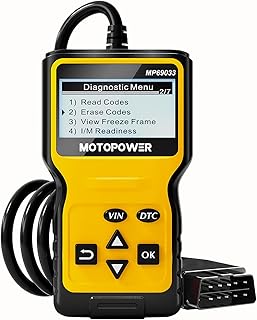
The MP69033 combines a broad protocol range with a clear 2.8-inch LCD display. It supports 9 protocols, including many 1996 US-based and later EU/Asian vehicles, and it powers directly from the car, without batteries. Features include code reading and erasing, freeze-frame viewing, I/M readiness checks, and the ability to retrieve vehicle information. Its compact, portable design makes it suitable for quick in-garage checks or roadside troubleshooting.
With multilingual support and a straightforward interface, the MP69033 targets users who want a practical, no-fuss diagnostic tool that can be used on a wide array of vehicles. The device emphasizes core diagnostic capabilities while offering helpful data like engine speed, coolant temperature, and vehicle speed to aid problem identification.
Buying Guide: Key Purchase Considerations
- Vehicle compatibility: Verify that the scanner supports your vehicle’s year, make, and model, as some tools cover only specific generations or regions.
- Scope of diagnostics: Decide between basic code reading/clearing and more advanced features such as live data streams, freeze-frame, I/M readiness, EVAP testing, and DTC lookup depth.
- Interface preference: Consider whether you prefer a standalone handheld device, a Bluetooth/Wi‑Fi scanner paired with a mobile app, or a PC-based tool for deeper analysis.
- Code definitions: A robust built-in database (thousands of DTC definitions) reduces the need to search online for meanings, speeding repairs.
- Power source: Some scanners draw power from the vehicle’s OBD II port; others rely on internal batteries. Determine which suits your workflow.
- Future-proofing: Look for updates, compatibility with newer protocols, and features like O2 sensor or EVAP monitoring if you anticipate evolving diagnostics needs.
- Ease of use: Larger displays, clear menus, and intuitive button layouts help both beginners and professionals operate the tool efficiently.
When selecting a code checker for your car, balance price against diagnostic depth, compatibility, and how you prefer to access data. For some users, a compact, battery-free reader suffices for quick checks. For others, a Bluetooth-enabled tool paired with a mobile app provides ongoing health monitoring and proactive maintenance insights across multiple vehicles.